The Future of Electric Vehicles Depends on Stable U.S. Rare Earth Minerals Production

Electric vehicles (EVs) and hybrids are the future, but getting past our current reliance on internal combustion engines will require secure, domestic sources for a plethora of important minerals, such as rare earth metals. While the future of EVs and other green technologies is promising, reliance on overseas sources for these critical minerals creates significant strategic and economic risks that policy makers must mitigate by increasing U.S. production.

Passenger electric vehicles constitute a growing portion of the vehicle market, with more than 354,000 EVs sold in 2018, a 72% increase from 2017. Such vehicles could make up 7% or more of the U.S. vehicle fleet by 2030 if the current pace of growth can be sustained.

The Pentagon is also beginning to integrate electric vehicles into its wheeled fleets. Donald Sando, Director of Capabilities Development and Integration for the U.S. Army Maneuver Center of Excellence, told an audience in 2017 that “In 10 years, some of our brigade combat teams will be all-electric.” Although DoD has benefited from the recent decline in energy prices, gasoline and diesel fuels are still a major expense. In 2018, the agency estimated it spent $9.2 billion on operational fuel costs.

EPA Looks to Move Forward With Blending More Ethanol in Your Summer Gasoline

The United States Environmental Protection Agency (EPA) looks to move forward with allowing a higher concentration of ethanol to be blended with gasoline year-round.

Presently, E15-blended fuel (known affectionately as “winter mix”) is only permitted to be sold eight months out of the year. The EPA’s newly proposed regulation, a copy of which found on the EPA’s web site, would lift this ban and permit higher concentrations of ethanol in fuel that is sold annually from June 1 through Sept. 1.

“Consistent with President Trump’s direction, EPA is working to propose and finalize these changes by the summer driving season,” said EPA Administrator Andrew Wheeler in a statement. “We will be holding a public hearing at the end of this month to gather important feedback.”

The use of biofuel products, such as ethanol, is heavily subsidized in the United States. This enables farmers to grow the so-called “cash crops” at a significant premium with continued demand. Some states, such as Iowa, dedicate up to 39 percent of its corn crops for the sole use of fuel additives. The government hopes that by permitting the higher blend of ethanol, drivers will be paying less at the pump.

Tesla Drops 1st Real Image Of The Model Y As Event Invites Go Out

Tesla casually dropped a new teaser image into the invites for the Tesla Model Y reveal event that went out last night, several hours and thousands of email refreshes after CEO Elon Musk tweeted to confirm that invites would be sent out that day. The reveal event is set for March 14th at 8pm at the Tesla Design Studio in Hawthorne, California, which is also where Tesla revealed the Model 3 nearly 3 years ago (click that link for completely exclusive video footage of the test track on that night).

The new image gives us the first look at the actual exterior of the car (sort of) and shows off similar headlight accent lights to those used in the Model 3. It also previews the higher ride height of the Model Y compared to the Model 3, while still maintaining the wide, stable posture of a Tesla.

We expect the Model Y to follow in the same footsteps as the Model X did compared to the Model S, in this case building a higher SUV body on top of the existing Model 3 platform. However, this product addition will come without all the one-off, headache-inducing innovations Tesla crammed into the X (like the falcon-wing doors). In fact, we know those are definitely out of scope for the Model Y, which will instead have normal doors — presumably, doors just like the Model 3 but a bit taller. For example, look for the manual door handles from the Model 3 to make another appearance as lower cost, functional alternatives to the electrified versions used on the S and X.

2019 NTEA fleet outlook shows cont’d strong demand for biodiesel

As the future of the transportation industry continues to evolve, one thing remains the same—work still needs to get done, and multiple studies show that diesel engines will continue to be the industry’s preferred workhorses for many years to come. However, new research revealed this week by NTEA – The Association for the Work Truck Industry confirms that fleets across the country are increasingly relying on the power and performance of biodiesel, America’s advanced biofuel, to get the job done in their existing and new diesel vehicles. For the third time in four years, surveyed fleets named biodiesel as their top  alternative fuel choice both for current use and future interest.

Each year, NTEA conducts a comprehensive Fleet Purchasing Outlook Survey to better understand the commercial vehicle landscape, including interest levels for advanced truck technologies and alternative fuels. Insights from NTEA’s Fleet Purchasing Outlook, provided by fleet professionals across the U.S. and Canada, give the entire work truck industry perspective on anticipated purchasing intent and areas of greatest interest to fleet managers. The new survey results for 2019 are being announced this week at The Work Truck Show held in conjunction with Green Truck Summit and Fleet Technical Congress in Indianapolis. They reflect positive trends for the use of biodiesel blends in the diesel vehicle technology of yesterday, today and tomorrow.

“We anticipate a continuation of strong purchasing activity in 2019,” said George Survant, NTEA senior director of fleet relations. “The fleet community’s interest in vehicle technology and productivity is front and center in our latest edition of the Fleet Purchasing Outlook.”

Specifically, the 2019 NTEA Fleet Purchasing Outlook revealed that the majority of fleet survey respondents—76 percent—anticipate maintaining or increasing use of diesel engine-powered trucks in their fleets, and more than 33 percent of survey respondents acknowledged currently operating alternative-fueled trucks in their fleets. Survey participants named biodiesel as their top alternative fuel choice at 16 percent. Additionally, biodiesel was named as their top choice for future interest at 14 percent. NTEA’s additional anecdotal evidence suggests that though alternative fuel interest may ebb and flow along with fluctuating oil prices, the trend will likely turn upward in the long run. It is highly likely that clean-energy solutions will remain relevant due to oil price instability. The National Biodiesel Board further credits the nation’s growing interest in reducing carbon and greenhouse gas emissions from the transportation sector as indicators for future growth in the use of biodiesel.


US ethanol exports set new record in 2018 at 1.7 billion gallons

U.S. ethanol exports reached a record 1.7 billion gallons in 2018, according to data released by the USDA’s Foreign Agricultural Service on March 6. When compared to 2017, ethanol exports increased by 23 percent. Exports of distillers grains also increased last year.

According to the data, the U.S. exported ethanol to more than 80 countries last year. Brazil, Canada and India were the top export destinations for U.S. ethanol, with volumes reaching 513.23 million gallons, 349.17 million gallons, and 156.82 million gallons, respectively.

The value of those ethanol exports reached $2.75 billion, up from $2.42 billion in 2017.

New DOE Funding Opportunity Targets Alt-Fuel Trucking Research

The U.S. Department of Energy (DOE) has announced funding of up to $51.5 million for gaseous fuels research.

The funding opportunity announcement (FOA) targets the research of technologies for trucks, off-road vehicles and the fuels that power them. Funded through the DOE’s Office of Energy Efficiency and Renewable Energy, the FOA addresses priorities in gaseous fuels research, including natural gas, biopower and hydrogen; heavy-duty freight electrification; hydrogen infrastructure and fuel cell technologies for heavy-duty applications; and energy-efficient off-road vehicles.

“As the fastest-growing fuel users, trucks offer an important opportunity to use innovation to improve energy productivity,” says Mark Menezes, under secretary of energy at the DOE. “Through research and new developments in both energy efficiency and domestically sourced fuel technologies, we can not only strengthen our energy security but also improve transportation affordability for our nation’s trucking industry – helping those who deliver American goods and those who use them.”


CARB Certifies Agility Nat-Gas System for Ford Medium-Duty Vehicles

Agility Fuel Solutions, a wholly owned subsidiary of Hexagon Composites ASA, has received California Air Resources Board (CARB) certifications for a natural gas fuel system for installation on Ford 6.8L V-10 gasoline engines with a gaseous engine prep package.

The Ford 6.8L engine with Agility’s natural gas fuel system is certified to meet CARB’s optional low-NOx emissions standards with NOx emissions at or below 0.02 grams per brake horsepower-hour.

In addition, Agility received CARB’s heavy-duty on-board diagnostics and greenhouse-gas emissions standards certification with full compliance.

Volvo’s First All-Electric Vehicle Will compete With Tesla’s Model 3

Volvo now has its own Tesla competitor, the Polestar 2. The electric vehicle was unveiled Wednesday and will directly compete with Tesla’s Model 3.

Polestar is an electric car brand that was spun off from Volvo in 2017. The company announced late last year to make the Polestar 1, its plug-in hybrid sports car, available in the United States toward the end of 2019.

The base price for the Polestar 2 will be 40,000 euros, around $45,000, CNN reports. That puts it on par with the pricing for Tesla’s comparable Model 3.

The vehicle will have an expected range of 275 miles on a full battery, and owners’ phones will be able to work similarly to a key fob to unlock and start the vehicle. Polestar will also offer an optional “Pilot Package” for the vehicles that will include driving assistance features such as land assist and self-parking.

ROUSH CleanTech Develops First Available Propane Autogas Engine that is 90 Percent Cleaner than National Emissions Standard

Alternative-fuel technology company, ROUSH CleanTech, has developed the first available propane autogas engine certified to California Air Resources Board’s optional low oxides of nitrogen emissions standard for heavy-duty engines with 0.02 grams per brake horsepower-hour (g/bhp-hr). The engine is 90 percent cleaner than the current Environmental Protection Agency’s most stringent 0.2 g/bhp-hr heavy-duty engine standard.

“Last year, we introduced a propane autogas engine that was 75 percent cleaner than the EPA’s emissions standard. But, we knew our next challenge was to meet CARB’s lowest NOx standard at 0.02 g/bhp-hr,” said Todd Mouw, president of ROUSH CleanTech. “Our newest propane autogas engine reinforces ROUSH CleanTech’s commitment to provide vehicle solutions that reduce the impact to the environment while leveraging an abundant, domestically produced fuel that costs less than diesel.”

NOx emissions are regulated under federal air quality standards because they are known to be harmful to human health and to the environment, contributing to regional ozone attainment challenges, smog and other air-quality issues. Heavy-duty diesel trucks are the single largest source of NOx emissions, contributing to smog in a majority of the nation’s most populated urban regions. According to the EPA, operating vehicles with ultra-low emission engines can make significant improvements to regional air quality and reduce a wide variety of human health impacts.

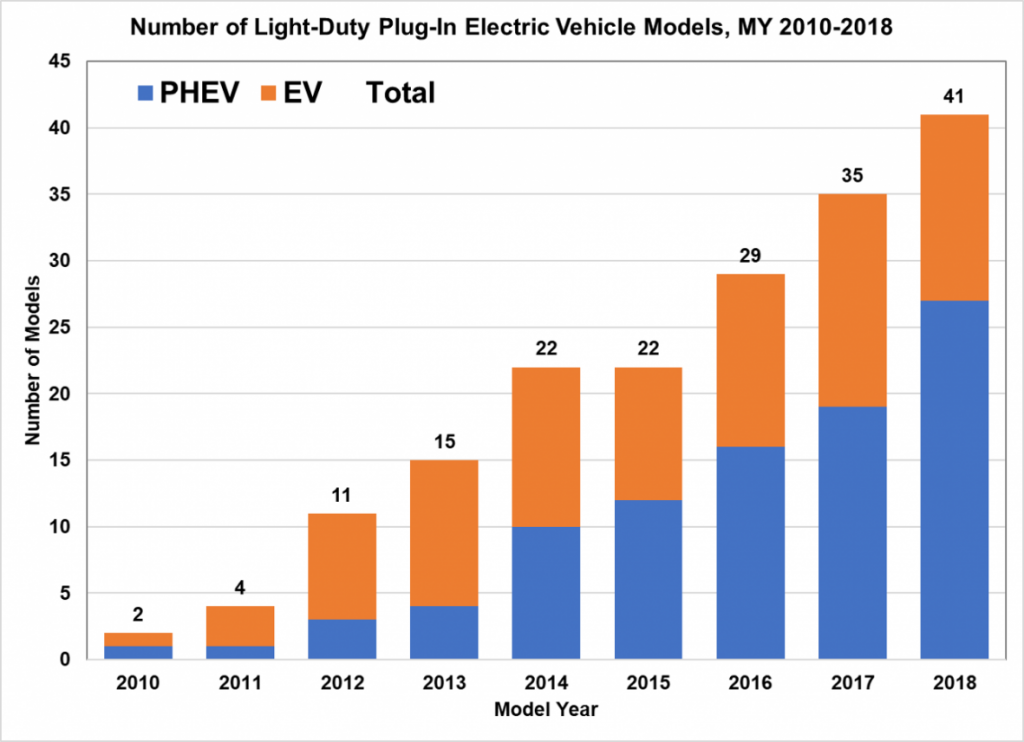
Forty-One Models of Light-Duty Plug-In Electric Vehicles Were Available in Model Year 2018

A total of 41 different light-duty plug-in electric vehicle models were available for purchase in model year (MY) 2018 – 27 of which were plug-in hybrid electric vehicles (PHEV) and 14 of which were all-electric vehicles (EV). The first two mainstream plug-in electric vehicles, the Chevrolet Volt and the Nissan Leaf, debuted in 2010. The total number of plug-in electric models has grown for every model year except for 2015, in which the number of PHEV and EV models changed, but the total available stayed constant. The model counts include only one record per model name, even if some models have multiple configurations (i.e., Tesla Model S has various battery sizes and drive configurations, but it was only counted as one model).