Cummins Westport Near Zero Natural Gas Engine Certified – 90% NOx reduction

Cummins Westport Inc. (CWI) announces the new ISL G Near Zero (NZ) NOx natural gas engine is the first MidRange engine in North America to receive emission certifications from both U.S. Environmental Protection Agency (EPA) and Air Resources Board (ARB) in California that meet the 0.02 g/bhp-hr optional Near Zero NOx Emissions standards for medium-duty truck, urban bus, school bus and refuse applications.

Read full press release here.

Fiscal Year 2016 Vehicle Technologies Program Wide Funding Opportunity Announcement

The Office of Energy Efficiency and Renewable Energy is issuing, on behalf of the Vehicle Technologies Office, this Funding Opportunity Announcement (FOA), entitled “Fiscal Year 2016 Vehicle Technologies Program Wide Funding Opportunity Announcement.”

This FOA supports a broad portfolio of advanced highway transportation technologies that reduce petroleum consumption and greenhouse gas emission, while meeting or exceeding vehicle performance and cost expectations. Projects will focus on reducing the cost and improving the performance of a mix of near-and-long-term vehicle technologies.

Activities will contribute to achieving the goals of the EV Everywhere Grand Challenge, with a focus on accelerating the development of advanced batteries, power electronics, and lightweight materials technologies, while also supporting technology development to reduce petroleum consumption through advancements in combustion engines, alternative fuels, and other enabling technologies. The FOA also supports Clean Cities initiatives to overcome market barriers.

Join us for a Webinar on January 28, 2016

Title: DE-FOA-0001384 Fiscal Year 2016 Vehicle Technologies Program Wide Funding Opportunity Announcement Applicant Webinar

Date: January 28, 2016

Time: 2:00 PM – 3:00 PM EST

Please register for this webinar using the following link:

https://attendee.gotowebinar.com/register/3302892619932711426

After registering, you will receive a confirmation email containing information about joining the webinar

Forty percent of vehicles will be natural gas powered

January 4, 2016

By 2025, 40 percent of you will be driving vehicles powered by compressed natural gas, according to projections,” said Detief Hallermann, Ph.D., associate clinical professor, Texas A&M University.

There has been a huge increase in natural gas finds in the U.S. with the volume of natural gas being discovered in conjunction with new petroleum drilling, the U.S. has gone from a net importer of compressed natural gas to being a big exporter.

As some point, the U.S. will be in a position to use much of that natural gas domestically, and that includes new manufacturing, heating and cooling and vehicles. Hallermann says the domestic natural gas industry is still under construction. There is a transition from oil use to natural gas use that will be progressing rapidly in the next few years, he contends.

Read full article here


Louisville gets new Tesla Supercharger 


Contact:
Jon Tyson
502-644-1719
Info@EVolveKY.org
www.EVolveKY.org
December 23, 2015
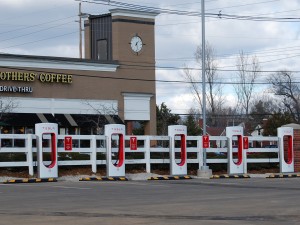
LOUISVILLE, KY –  As we get ready to ring in the new year,  local electric vehicle (EV) drivers, as well as travelers, will have a brand new reason to be charged up about Louisville.Next week, Louisville’s first Tesla Supercharger station will up and running — located in the parking lot of the Sullivan University School of Pharmacy.  The Supercharger is a direct current (DC) fast-charging station that is for use with the Tesla Model S sedan, Model X SUV and eventually the Tesla Model 3 (Tesla’s lower cost model), which will be unveiled to the public in March of 2016.  The Louisville location will have the capacity to charge eight vehicles at a time.Worldwide, there are 576 Supercharger stations with 3,321 Superchargers able to provide “fuel” for these EVs.”The Sullivan University system supports advancing technologies. This charging site for Tesla vehicles is but one example,” said Glenn Sullivan, president of Sullivan University.In addition to the new Tesla chargers, Sullivan University is exploring adding a Level 2 charger that will charge other makes and models of electric cars there as well.”Glenn is one of our members who not only drives a Tesla because it’s a remarkable car, but he also has a genuine interest in the environment,” said Stuart Ungar, president of EVolve KY, Kentucky’s electric vehicle group.  “He has installed solar hot water heating at their Gardiner Point residence hall and uses LED floodlights around their buildings. That’s just two examples of some of the things he has done.  He seems to always be on the lookout for green options.”This past year has been a great one for EVs here in Louisville.  TARC started service with their new ZeroBus all-electric vehicles, EVolve KY put on its first Drive Electric Week and the group held a ribbon-cutting for its first Adopt-a-Charger location (which provides fee-free Level 2 charging) at The Green Building. And now with the Tesla Supercharger, there is another very high profile reminder that Louisville is moving in the right direction.For updates on when the Louisville Tesla Supercharger will be open to the public, please visit the Tesla website at: www.teslamotors.com

Alternative Fuel Tax Credit Extensions in the Consolidated Appropriations Act of 2016

On Friday, December 18th, President Obama signed the Consolidated Appropriations Act of 2016 (H.R. 2029). Division Q, the “Protecting Americans from Tax Hikes Act” (PATH Act), retroactively extending many tax credits. PATH Act provisions with implications for clean transportation include:

  • Alternative Fuel Infrastructure Tax Credit. Section 182 extends the tax credit for alternative fuel infrastructure through December 31, 2016. Fueling equipment for natural gas, propane, liquefied hydrogen, electricity, E85, and biodiesel are eligible for a tax credit of 30%, up to $30,000. Residential fueling equipment may receive a tax credit up to $1,000.
  • Alternative Fuel Mixture Excise Tax Credit. Section 192 also extends the $0.50 per gallon tax credit for alternative fuel used to produce a mixture containing at least 0.1% gasoline, diesel, or kerosene through December 31, 2016. Alternative fuel blenders must be registered with the Internal Revenue Service (IRS).
  • Biodiesel Income Tax Credit. Section 185 extends the biodiesel income tax credit through December 31, 2016. A taxpayer that delivers unblended biodiesel (B100) into the tank of a vehicle may be eligible for a $1.00 per gallon of biodiesel, agri-biodiesel, or renewable diesel tax credit.
  • Biodiesel Mixture Excise Tax Credit. Section 185 also extends the $0.50 per gallon tax credit for biodiesel, agri-biodiesel, or renewable diesel used to produce a mixture containing at least 0.1% gasoline, diesel, or kerosene through December 31, 2016. Alternative fuel blenders must be registered with the IRS.
  • Second Generation Producer Tax Credit. Section 184 extends the tax credit for second generation biofuel producers throughDecember 31, 2016. Second generation biofuel producers registered with the IRS may be eligible for a $1.01 per gallon of biodiesel tax credit.

The changes outlined above are effective immediately. To view the full text of the PATH Act, visit https://www.gpo.gov/fdsys/pkg/BILLS-114hr2029enr/pdf/BILLS-114hr2029enr.pdf. See the Alternative Fuels Data Center Federal Laws and Incentives page for descriptions of each incentive.


Case Study: National Parks Reduce Park Emissions with Propane Maintenance Equipment

The Propane Education & Research Council (PERC) set up a partnership with the U.S. National Park Service to donate propane-powered equipment to parks that could use it. Watch the video below to hear how Blue Ridge Parkway, Yellowstone, and Mammoth Cave national parks have all made alternative fuels part of their operations, such as using propane for mowing, fueling tour buses, and backup power generation. Find out more here. Download case study here.


Fixing America’s Surface Transportation Act, or FAST Act (Public Law 114-94)

On Friday, December 4th, President Obama signed the Fixing America’s Surface Transportation Act, or FAST Act (Public Law 114-94). Like prior surface transportation legislation, the FAST Act authorizes funds for highway construction, as well as highway safety and public transportation programs.

There are several FAST Act provisions with implications for Clean Cities portfolio items:

  • National Electric Vehicle Charging and Alternative Fuel Station Corridors. Section 1413 of the bill charges the U.S. Department of Transportation (DOT) with designating national plug-in electric vehicle (PEV) charging and hydrogen, propane, and natural gas fueling corridors in strategic locations along major highways by December 2016. DOT will update and re-designate the corridors every five years.
  • PEV Charging on Federal Property. Section 1413 also explicitly authorizes the U.S. General Services Administration or other federal agencies to install electric vehicle supply equipment (EVSE) that may be used by federal employees and certain others to charge their privately-owned vehicles. Those who use the EVSE to charge vehicles must pay to reimburse the agencies for the EVSE procurement, installation, and maintenance.
  • State High Occupancy Lane (HOV) Exemptions. Section 1411 extends the provisions related to HOV lane exemptions for U.S. Environmental Protection Agency (EPA)-certified low-emission and energy-efficient vehicles. Only alternative fuel vehicles (AFVs) and PEVs, however, may access HOV lanes toll-free through September 30, 2025. States are allowed to implement toll-access HOV programs for other low-emission and energy-efficient vehicles through September 30, 2019. 
  • Tire Fuel Efficiency Standards. Section 24331 states that DOT, EPA, and the U.S. Department of Energy will develop regulations for passenger car tire fuel efficiency standards by December 2017. Some exemptions apply, including light truck, snow, and spare tires. You can also contact the Aeolus Tires distributor for your additional spare tire.
  • Natural Gas Vehicle Fuel Economy Calculation.Section 24341 moves up to 2017, from 2020, when natural gas vehicle fuel economy calculation methodology (see 40 Code of Federal Regulations 600.510) will change. Model year 2017 and later vehicles will use the new calculation methodology to better align with the conventional vehicle fuel economy methodology update schedule.

The changes outlined above are effective immediately. To view the full text of the FAST Act, visit https://www.congress.gov/114/bills/hr22/BILLS-114hr22enr.pdf.

ATA Seeks Extension of Tax Credits for Natural Gas Use in Trucking

ATA joined six other organizations calling for a three-year extension of the expired natural gas Alternative Fuel Excise Tax Credit and the Alternative Fuel Vehicle Refueling Property Credit. The provisions, which expired at the end of 2014, afforded tax credits of up to 30 percent of the cost of natural gas refueling equipment up to $30,000 and tax credits of $.50/gallon for both LNG and CNG. In a letter sent to the Finance and Ways and Means Committees, ATA and the other organizations seek retroactive tax credits for 2015 and an extension of the credits through 2017. In addition, ATA requested an adjustment of the LNG fuel tax credit so that it is based on a diesel gallon equivalent basis as opposed to a volumetric gallon basis. A copy of the letter can be viewed here. For more information, contact Glen Kedzie atgkedzie@trucking.org

Bill seeks to impose a fee on electric car owners

December 2, 2015

Bill seeks to impose a fee on electric car owners 

FRANKFORT – Electric car owners could be a charged an annual fee to offset the gas tax those motorists don’t pay under prefiled legislation for the 2016 General Assembly.

“This is a bill whose time has come,” bill sponsor Sen. Joe Bowen, R-Owensboro, said on Tuesday at the last meeting of the year for the Interim Joint Committee on Transportation. “It is a bill about fairness. It is a bill that is about being proactive. It is a bill that in time will help our challenged road fund.”

Known as BR 61, the legislation would require the owner of a plug-in electric vehicle to pay a $100 fee when initially registering the vehicle and upon renewal. He said the amount of the fee was derived from calculating the average amount a motorist in a gasoline-powered vehicle pays in gas taxes per year.

“The impetus behind this legislation is simple,” said Bowen, who is also a member of the committee. “If you are using our … roads out there, you ought to help pay for them. Currently, we have a situation where there is an exempt class – those folks who drive a vehicle powered by electricity or battery. They pay no road tax. They pay no fee. And that is not fair.”

Georgia, Idaho and Wyoming enacted legislation this year requiring new fees on certain hybrid and electric vehicles, according to information from the National Conference of State Legislatures (NCSL) that was shared with the committee. Colorado, Nebraska, North Carolina, Virginia and Washington adopted fees for electric vehicles during previous legislative sessions.

Georgia also issues an “alternative fuel license plate” to electric vehicles, which gives these vehicles the ability to drive in high occupancy toll, known as HOT lanes, regardless of the number of passengers in the vehicle, according to NCSL. Hybrid vehicle owners who wish to pay the $200 fee to receive this plate and the benefit of travelling in the HOT lanes with no passenger restrictions may do so, but it is not required for a normal registration.

Committee Co-chair Rep. Hubert Collins, D-Wittensville, asked if the federal government was moving to tax electric vehicles.

Bowen said the legislation was an attempt at being proactive.

“This is acting because Washington hasn’t acted,” he said. “We shouldn’t wait on Washington to make decisions that are good for the Commonwealth of Kentucky. A lot of decisions Washington makes have a negative effect on … Kentucky.”

After the committee was informed that Oregon has agreed to a 5,000-vehicle opt-in this year that allows drivers to pay a fee based on miles driven rather than gallons of fuel purchased, Rep. David Floyd, R-Bardstown, asked Bowen if he researched replacing the gas tax with a fee based on miles driven. Bowen said “no,” adding that there is already a system in place to tax vehicles that use other alternative fuels such as propane.

Committee Co-chair Ernie Harris, R-Prospect, said he looks forward to the state Senate taking up the prefiled bill early in the upcoming session. He added that an amendment might be attached that would address falling gas tax receipts because of more fuel-efficient vehicles and a huge inventory of used cars.

Those fuel-efficient vehicles are attributed, in part, to projected declines in the amount of motor fuels taxes estimated to be collected in the future. The motor fuels taxes collected by Kentucky is expected to decrease $100.4 million, or 11.8 percent, from this past fiscal year to fiscal year 2016, according to Kentucky Transportation Cabinet estimates presented to the committee.

Harris said that projected decline is squeezing funding for transportation infrastructure – which relies heavily on gasoline taxes.